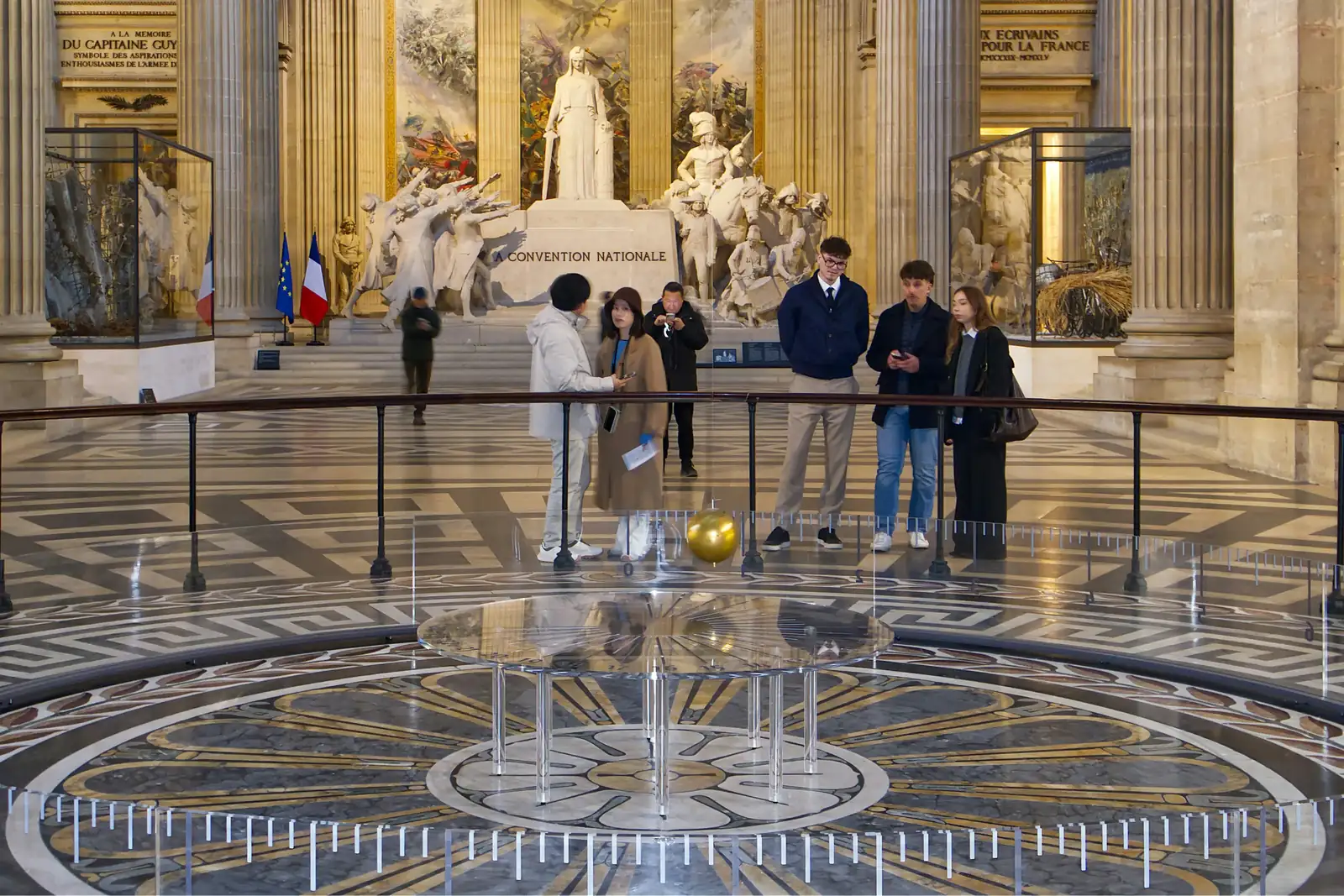
Who's actually down there
The crypt runs in a series of vaulted chambers beneath the whole building, and the names that draw the most visitors share it with dozens of Napoleonic dignitaries most people walk straight past.
Voltaire and Rousseau
The Enlightenment's two great rivals lie in the crypt's entrance chamber, facing each other — Voltaire placed there in 1791, Rousseau in 1794.
Napoleon's dignitaries
Under Napoleon, forty-one people were placed in the crypt, mostly officers, senators and senior office-holders, along with the navigator Louis-Antoine de Bougainville, the painter Joseph-Marie Vien and the mathematician Joseph-Louis Lagrange.
Hugo, Zola, Dumas
Victor Hugo was buried here in 1885 and Émile Zola followed in 1908. Alexandre Dumas joined them in 2002, 132 years after his death; the three writers share one chamber.
Jean Moulin, the Curies, André Malraux
Resistance leader Jean Moulin entered in 1964. Marie Curie came in 1995 with Pierre Curie — the first woman honoured here on her own merit — and André Malraux in 1996.
Four Resistance figures, then Simone Veil
Jean Zay, Pierre Brossolette, Germaine Tillion and Geneviève de Gaulle-Anthonioz entered in 2015, the two women by symbolic coffins at their families' wish. Simone Veil followed in 2018 with her husband Antoine.
Joséphine Baker and the Manouchians
Joséphine Baker was honoured in 2021 with a cenotaph, her body remaining in Monaco. Missak and Mélinée Manouchian entered on 21 February 2024, eighty years to the day after Missak's execution.
Robert Badinter, then Marc and Simonne Bloch
Badinter, who abolished the death penalty as justice minister, was honoured on 9 October 2025, the law's anniversary. The historian and resistance fighter Marc Bloch followed with his wife Simonne on 23 June 2026.
Panthéonisation — the act of moving or honouring someone here — is decided by the President of the Republic and is rare: more than eighty people in over two centuries.
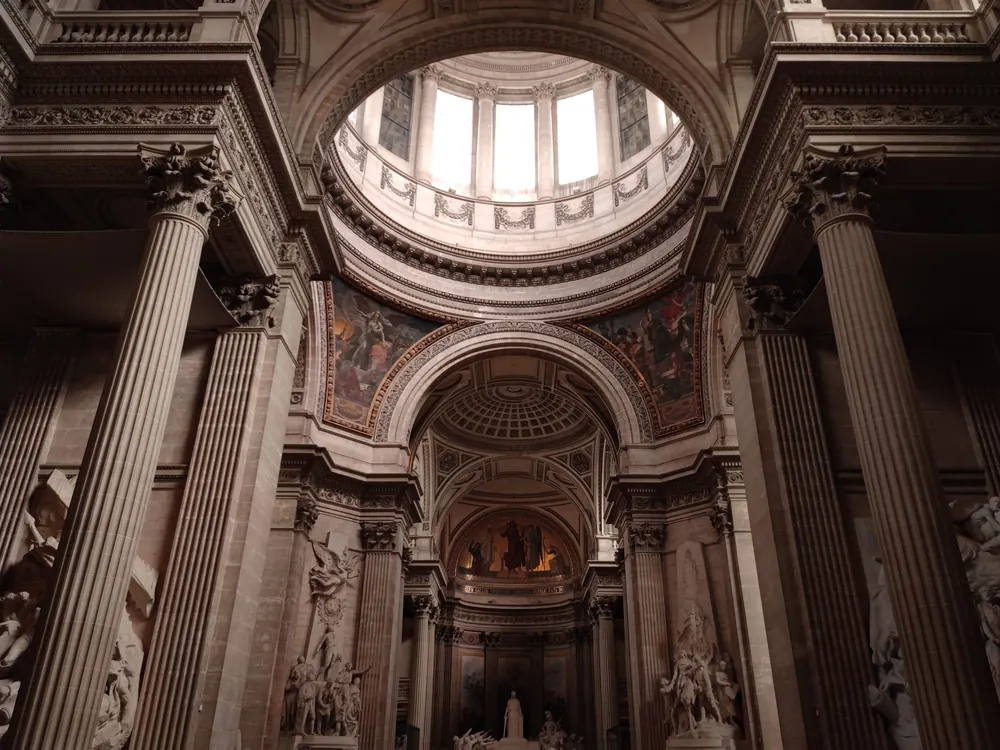
What the building actually is
A king's vow, finished by a revolution
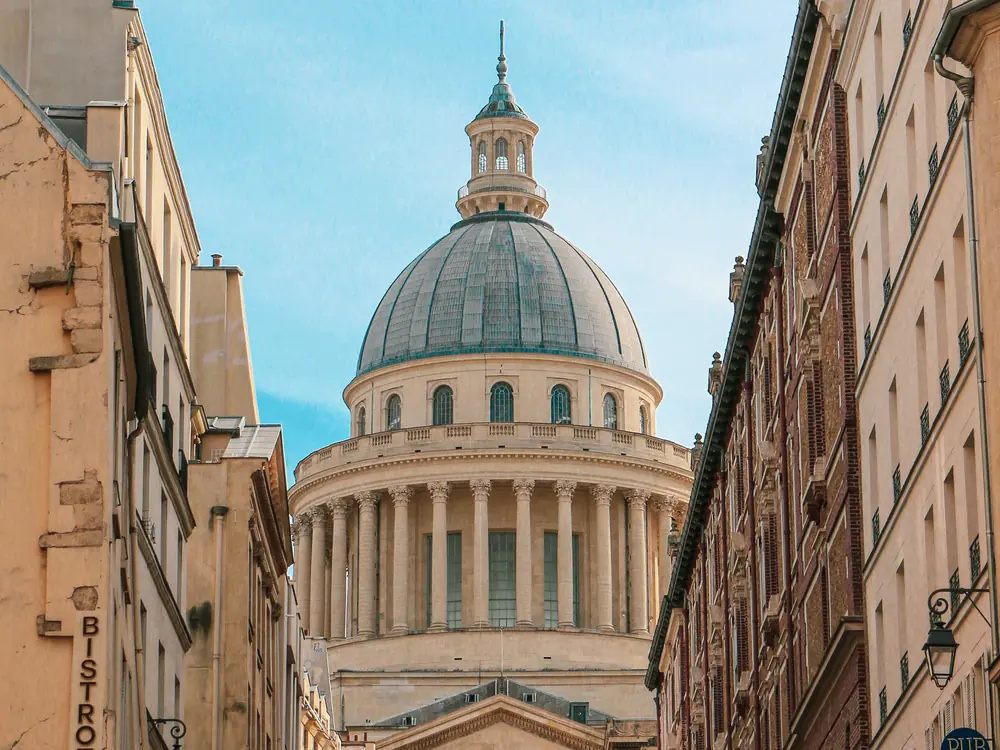
Louis XV vowed in 1744 that if he recovered from illness he would rebuild the abbey church of Sainte-Geneviève. Work began in 1758 to Soufflot's design and was completed in 1790, after his death, by which time the Revolution had begun — and in 1791 the National Constituent Assembly turned the new church into a mausoleum for distinguished French citizens.
It couldn't decide what it was for almost a century
Secularised in 1791, the building went back to the Church under Napoleon, became the Panthéon again in 1830, returned to the Church in 1852 under Napoleon III, and was made a mausoleum once more in the 1880s — Victor Hugo, buried here in 1885, was the first great name to enter after that final switch. It has been a mausoleum ever since.
The dome is a separate visit, when it opens
A stone colonnade wraps the dome, reached by around 200 steps. In past seasons it has opened from April to October as a separate, booked visit, but the monument's own site currently lists the panoramic view as closed to visitors — check there before planning around it.
Entry is free for some visitors, whatever else you book
The monument's own site lists free admission for under-16s with an adult, for EU nationals and regular residents of France aged 16 to 25, and for disabled visitors with a companion. Worth checking before anyone looks at tours, because it changes who needs a ticket at all.
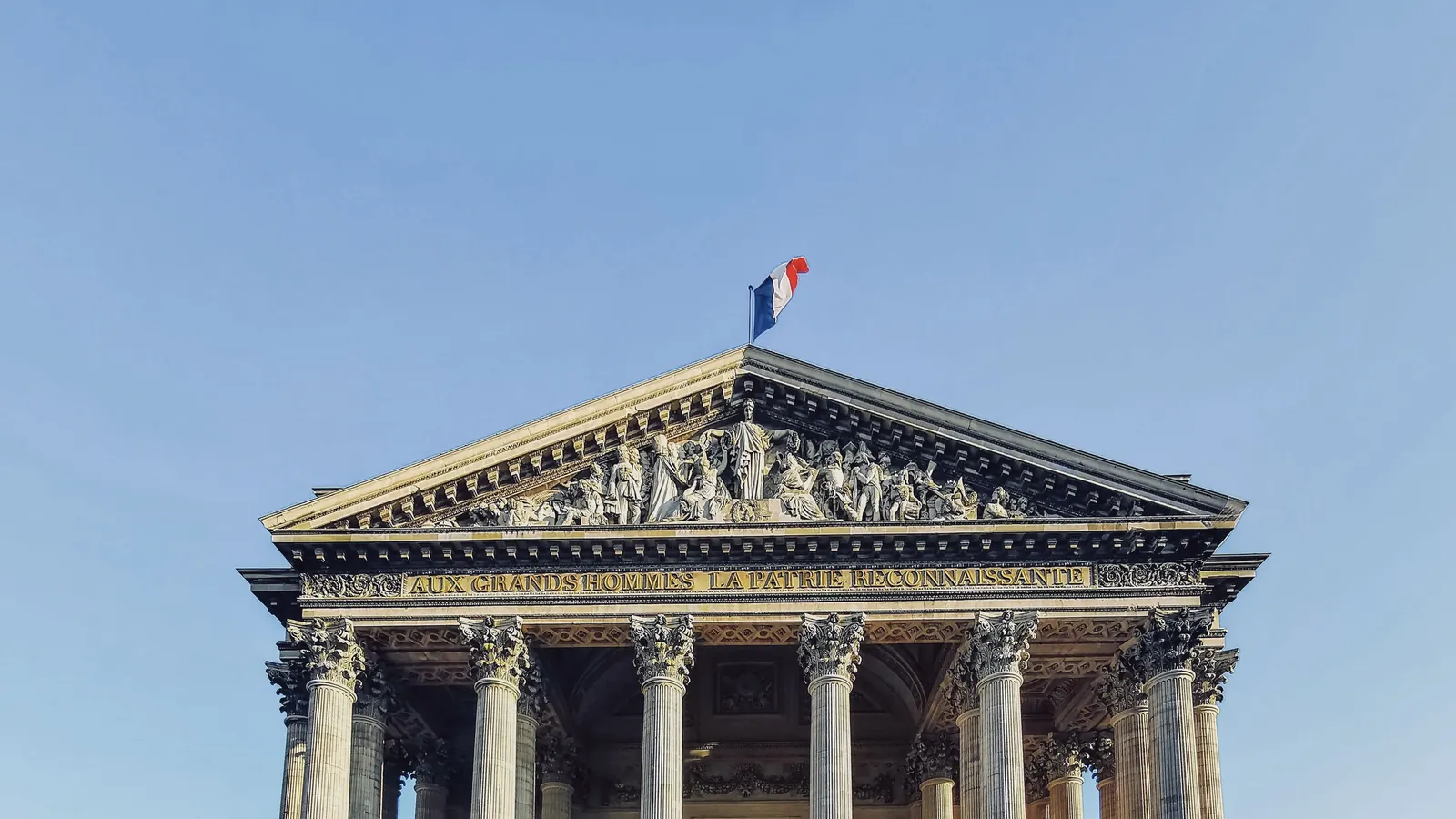
Before you go
A handful of facts worth knowing before you plan around a specific day or time.
Check the day before you go
Hours change between summer and winter, the building shuts on 1 January, 1 May and 25 December, and it opens later than usual on the first working Monday of each month. The monument's own site has the current times.
It can close for a ceremony with little notice
A panthéonisation takes over the nave, so the monument can close or change its hours around a ceremony — a reason to glance at its calendar before locking in a fixed date.
The address sits on top of a hill
Place du Panthéon, in the 5th arrondissement, at the top of the Montagne Sainte-Geneviève. Most approaches on foot finish with a climb.
The nave is accessible; the crypt and dome are not
An outside ramp and an inside lift give access to the whole nave. The crypt is reached only by stairs — around 40 steps — and the monument's own access notes say it is not accessible to wheelchair users; a virtual-visit screen in the nave shows it instead.
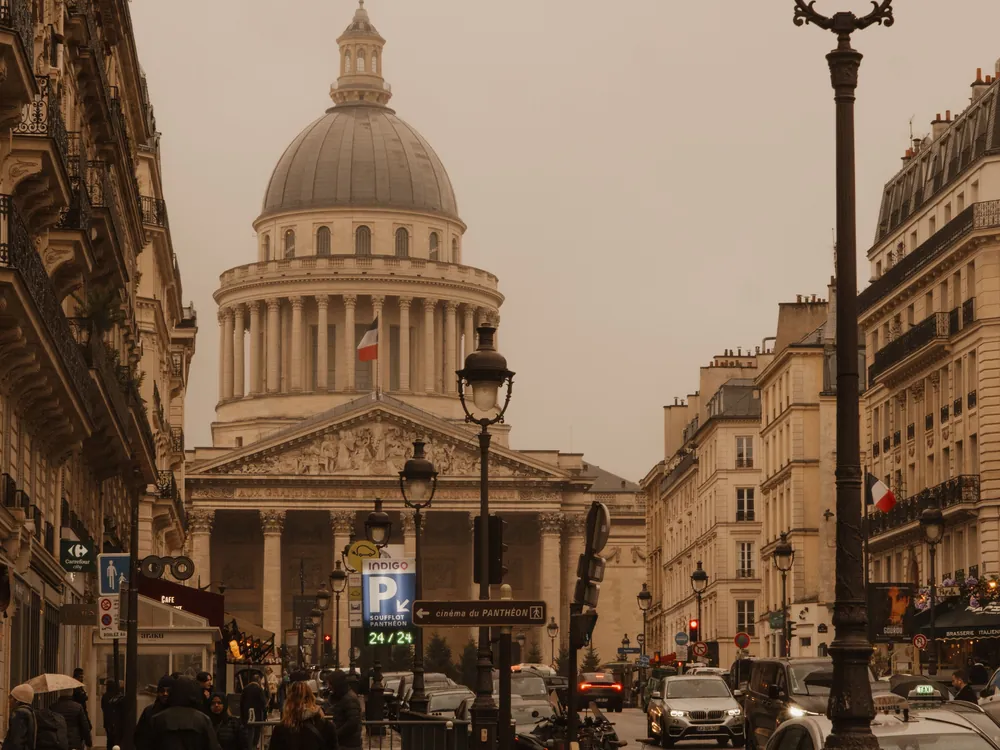
Two ways to see it, both on Viator
Two kinds of Panthéon listing on Viator
| Option | What it covers | Good for |
|---|---|---|
| Entry ticket | Admission to the nave and crypt — the same areas the monument's own ticket covers | Adults who want to go at their own pace (under-16s with an adult get in free) |
| A Latin Quarter walking tour that includes it | A guided walk around the Montagne Sainte-Geneviève with entry to the monument | First-time visitors who want context before they go in |
Getting there
By Métro
Line 10 stops at Maubert-Mutualité and Line 7 at Place Monge, both several minutes' walk from the square.
By RER
RER B stops at Luxembourg, a short uphill walk along rue Soufflot to the square.
By bike
A Vélib' bike-share station, Panthéon – Valette, sits right beside the monument.
On foot
Every route into Place du Panthéon finishes uphill — the building sits at the top of the Montagne Sainte-Geneviève. Allow a few extra minutes if stairs or slopes are a concern.
Guides to the Panthéon
Eight pieces covering the names in the crypt, the dome, the pendulum and the logistics.
Who's inside
Who is buried in the Panthéon
More than eighty names, from Voltaire in 1791 to Marc and Simonne Bloch in 2026 — everyone in the crypt, in the order they entered.
Open this guide →The dome climb
The Panthéon dome walk and the view from the top
Around 200 steps to a colonnade wrapping the dome — what the view takes in, and why to check it's open before planning around it.
Open this guide →The pendulum
Foucault's pendulum at the Panthéon
A 28-kilogram bob on a 67-metre wire, hung under the dome in 1851 to make the Earth's rotation visible.
Open this guide →Inside the crypt
A walkthrough of the Panthéon's crypt
Reached by stairs from the nave, the crypt's vaulted chambers hold more than eighty names, from Voltaire to the Blochs.
Open this guide →Timing
The best time to visit the Panthéon
Three different visits stacked in one building — the nave, the crypt and the dome — and each one has its own timing.
Open this guide →Three domes
Panthéon vs Les Invalides vs Sacré-Cœur
Three domes break the Paris skyline for three different reasons — a crypt of citizens, an emperor's tomb, and a basilica built as a vow.
Open this guide →With children
The Panthéon with kids
The pendulum is the easy sell; the crypt works best as a short hunt for specific names rather than a read-every-plaque march.
Open this guide →The ceremony
How panthéonisation works
More than eighty people in over two centuries — the rare process for entering the crypt, and who's gone in most recently.
Open this guide →Common questions before a visit
Is this the same domed building people visit in Italy?
No. The name is borrowed from a much older domed temple in Italy, but the two buildings are unrelated — this guide, and the Viator listings linked from it, are entirely about the Paris monument on the Montagne Sainte-Geneviève.
Who runs the Panthéon?
The Centre des monuments nationaux, the French public body that manages a long list of national monuments. Its own site is paris-pantheon.fr. This guide is independent and not affiliated with it in any way.
Can I climb the dome?
Not at the moment, according to the monument's own site, which lists the panoramic view as closed to visitors. In past seasons the colonnade, around 200 steps up, has opened from April to October as a separate, booked visit — check its status before building plans around the view.
Who is actually buried in the crypt?
More than eighty people, added one or a few at a time since 1791. Voltaire and Rousseau are the earliest still there; Marc and Simonne Bloch, honoured in June 2026, are the most recent. Our crypt guide lists every name in the order they entered.
Is entry free for anyone?
The monument's own site lists free admission for under-16s with an adult, for EU nationals and regular residents of France aged 16 to 25, and for disabled visitors with a companion. Beyond that, entry is ticketed.
How long does a visit take?
An hour covers the nave, the pendulum and the main crypt chambers at a comfortable pace. Allow longer if you want to read every name in the crypt.
What is Foucault's pendulum, and is it still there?
An 1851 demonstration that a swinging pendulum's path appears to rotate because the Earth is turning beneath it. The original bob is now kept at the Musée des Arts et Métiers; an exact copy has swung under the Panthéon's dome since 1995.
Is the Panthéon good for kids?
The pendulum holds most children's attention on its own. The crypt works best if you turn it into a search for a handful of specific names rather than reading every plaque — our family guide below sets out a route that does that.
The Panthéon is managed by the Centre des monuments nationaux; current hours, admission terms and visiting conditions are on the monument's own site.
- Independent guide We research and write about the monument; we don't run the booking ourselves
- No markup added Prices shown are Viator's own — a booking earns us a commission, never an amount added to what you pay
- Secure checkout Payment is handled entirely inside Viator's checkout flow
- Cancellation terms up front Viator shows each listing's cancellation window before you confirm